“What if you never happened to believe in the first place that that the most extraordinary aspects of your being came FROM you but maybe if you just believed they were on loan TO you, from some unimaginable source for some exquisite portion of your life to be passed along when you’re finished with somebody else. And if we think about it this way, it changes everything.” ~ Liz Gilbert, TED Talk
- Hockey & Sarah, A Love Story
I am three years old, riding in our 1971 tan Plymouth Valiant with black leather seats that burn the bottom of my legs in the summer. The cars outside the window are passing us. “Faster Mommy, they’re beating us,” I say.
*
I am four years old, finally old enough to learn to skate like my big brother, Jon. It’s a family outing as my brother, parents, and I all don skates at the Winnetka Ice Rink. But my skates are white, and I want black skates like my brother’s. My Dad carries me on to the ice and sets me down. All around us, kids and adults circle the orange cones. But I sit down and refuse to stand up until my parents give me black skates like my brother. I don’t cry, I simply refuse to move despite cajoling and encouragement and frustrated edicts. Embarrassed and frustrated, my parents acquiesce and trade the white figure skates for black hockey skates. It’s the beginning of my hockey career.
A few months later, I start hockey in earnest . It’s house-league, the entry level tier of youth hockey. I’m given a red jersey. Other kids slip green, white, and blue jerseys over their heads and smile. We’ll play them throughout the winter, outside on chewed-up ice with chain link fencing instead of fresh zambonied indoor ice with plexi-glass siding and boards without holes and dents. For each house-league game, my parents dress me at home in the living room from helmet to skate guards. Then I grab my stick and walk across our gravel driveway to the Valiant. On the way to the rink, my helmet-clad head is just visible over the passenger side door as a woman pulls up beside us. She laughs, smiles, and waves. I wave back with my hockey-gloved hand. At the rink, I want all the ice time I can get. I volunteer to play anytime another team is short, and even when they aren’t. I stop only to get hot chocolate and heat my freezing toes and hands by the fire. I love hockey, I love everything about it. I only wish I could play all week instead of just once on the weekends. That would be heaven.
*
I am six years old and a very proud member of the Mite A Winnetka Warriors hockey team. I am the only girl on my team and will be for another twelve years. We don’t have a regular goalie; instead, we rotate who will put on the communal goalie equipment and stand between the pipes. When my turn comes, I fall immediately and deeply in love, with the equipment, with the head to head competition, and with myself as a goalie. I am good at stopping the puck, even as little kids swipe willy-nilly in random chaos. And I intrinsically hate to be scored on; in practice, in games, or in the basement with my brother. I hate being beaten. I beg my parents to let me play goalie, but they want me to learn to skate. As the season progresses, sometimes I skate out, which I like very much, and sometimes I play goalie, which I love.
One day toward the end of the season, I’m walking around the rink looking for pucks during my brother’s practice when my Dad catches up to me and says he has a surprise in the lobby. Surprises are rare in my family, and I’m giddy with excitement as I follow my Dad through the lobby doors. He ducks behind a bench and emerges with a pair of hockey pads. I recognize them instantly. They are hand-me downs from the goalie on my brother’s team. “They are yours,” my Dad says. I pull them to my chest and inhale their lived-in smell. The pads are dark brown canvas on the outside, light brown canvas on the side inside, with three brown leather straps adorned with silver metal buckles that chime together when I walk. CARLSTAT is written in heavy black marker on the inside of the pads, but it has been crossed out. Below the old name, my Dad has written our phone number. They are really mine. Though I’m not wearing skates or any other equipment, I flop face down on the floor while my Dad buckles the new pads onto my legs. When I stand up, I am a goalie.
I wear my new pads all the time. I wear them to play hockey in the backyard with tennis balls. I wear them in the basement where my brother and I use red spray paint to mark a 10’ x 15’ hockey rink on the cement floor. I wear them to the dinner table. I wear them to bed until my parents forbid my new sleep attire. Instead, my goalie pads lay beside me like a trusted loyal dog as I go to sleep. When Halloween rolls around, I dress in my new goalie pads and tromp from house to house.
“Look, how cute, she’s dressed as a goalie,” the adults beam as they hold out a bowl of candy.
“I AM a goalie,” I respond. At Christmas, I beg my parents for a blocker. I am relentless in that way only children can be and on Christmas day, I get my wish. But the blocker has a mitten instead of an individually fingered glove. I don’t want to hurt their feelings, and I’m so happy to have a blocker, but I’m also devastated. My parents look perplexed. It’s clear they don’t understand why it matters, but they return the errant piece of equipment for a blocker with fingers. It is the beginning of a long, serious, and persnickety relationship with my equipment.
We win the Mite A State Championship that year. At the end of the year banquet, I receive a green sweatshirt that has my number, #1, written in yellow on the left front chest. I revel in its double meaning.
*
I am seven years old and have just finished tryouts for Wally Kormylo’s Glenview Mite AA team. I wait diligently by the phone instead of playing outside. Wally is a legend in the hockey world, consistently producing beautiful skaters and state championship teams. The phone finally rings. My Dad picks up and with raised eyebrows, hands me the phone. “Its Wally and he wants to talk to you.” Wally wants to talk to me, not my parents. It is the first time I’m truly treated as an adult by a stranger. Wally tells me he would love to take me on his team, but the other goalies are older. “I’m sorry. You are a great goalie, but you didn’t make my Mite AA1 team.” I’m sad and upset, but Wally is so nice, I actually feel good when I get off the phone.
The next call is from Mike Weiss, coach of the Mite AA2 team. He tells me I made his team. Mike is a kind man with thinning black hair and black rimmed glasses who wears only one outfit: blue polyester sweats with red and white stripes down the side and the red Glenview Stars red hockey jacket. It’s my first year as a full time goalie and I am in heaven. But I’m also growing and need new pads. So halfway through the season, I go shopping with my parents and pick out a pair of D&Rs. Compared to my old canvas pillows, my new pads are stiff and restrictive, like wearing casts on both my legs. I hate them. I beg my parents to let me wear my old pads. “It’s an important game,” I say. “I need to be able to practice, I can’t MOVE in those.” One day, my old pads disappear entirely. I am beyond angry. I hate my new pads, they feel like splints. Even when I wear them around the house to try to break them in, they still feel restrictive and awful. But I love my red white and blue jerseys, and my Glenview Stars hockey jacket, and the white jersey bag one of the mothers made for every member of the team with our names and numbers sewn in red and blue. I choose #00, and it is the only number I will wear until college.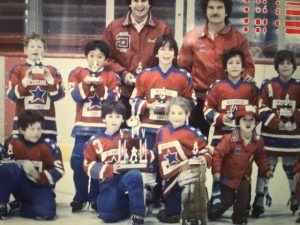
Towards the end of the season, when my new pads are finally feeling comfortable, our Mite AA2 team meets Wally’s Mite AA1 team in the NIHL tournament. Winners of the NIHL tournament get a big blue patch in the shape of Illinois to add to their hockey jacket. Wally’s team has always, always, won both NIHL and State; but on this day, a huge upset occurs, and the Mite AA2 team beats the Mite AA1 team. On the ice after the game, Wally gives me a huge, excited, avuncular hug. He tells me I played a tremendous game, and pats me repeatedly on the on the top of my bubble helmet. It is shocking to realize he isn’t mad at me. He is, in fact, incredibly proud. Even though we beat his team.
At the end of the season banquet, I write that I want to be a lawyer and an Olympic runner when I grow up. Afterwards, Mike stops my mom and me in the parking lot. “I have something for you, wait here.” When he returns, Mike is carrying a team trophy we won mid way through the season. He says I was MVP of the tournament and he thinks I should have the team trophy in addition to the individual one I’d already received. The trophy is nearly as tall as I am. I am so happy. I love trophies, and I sleep with that one next to my bed for days.
*
I am 8 years old, its summer, and I’m at goalie camp for the first time. There are twenty-five goalies ranging in age from six to high-school. Chico Andratas is our coach, he wears goalie skates and hands out t-shirts that say “The Puck Stops Here” and “Forwards Are Stupid.” Camp consists of three parts: dry-land training, on ice practice with different stations, and post ice videos where we watch ourselves and are critiqued. During dry-land, Chico tells us stories about Jacques Plante and Glenn Hall, goalies who played with broken arms and broken cheek bones and deep cuts from skates. He also teaches the mental aspect of goaltending by introducing us to visualization. Each day, he walks us through save after save, all in our minds eye, “Watch the puck into your glove, watch the puck hit your blocker.” And he teaches us attentional focus by giving each of us a puck to hold in our hands while he attempts to distract us by tying shoe laces together, flicking our ears, pulling on my pony tail, or cracking jokes. If we look up or our eyes leave the puck, we have to run. I can still hear is voice, “Stare at the puck, don’t let me distract you, stare the puck. Nothing but the puck. Stare at the puck.” Focus is a useful skill when many years later, to make a mistake is to have a red light go on behind me followed by dead fish thrown at me or sunscreen (red light burns). Or to have fifteen thousand Canadians simultaneously chant Sarahthen call me a sieve, Sieve! Sieve! Sieve!! “Stare at the puck, nothing but the puck.” I don’t know what the future holds at the age of eight, all I know is when a goalie makes a spectacular save, Chico gets down on his knees and bows to the goalie. And that feels really good. Chico creates an identity for and community of goaltenders, with our own language, history, heroes, and skills.
The last day of camp is always marked by a shootout. I hate shootouts. They change the outcome of a game from team-based to individual-based, but they are where goalies can shine. The prize for winning is an adult Wilson goalie glove that takes up half my body. I want that glove. In the shootout, I can’t miss. Even against older shooters, I am amazing and beyond all odds, I win. I ignore the older goalies who say the shooters took it easy on me. Because it isn’t true. Thirty years later, I still have the glove. It is a relic. And inside is a tiny yellow jersey, disintegrating now, that says, “Midwest Goalie School.”
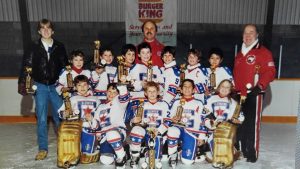 In the fall of the same year, I make Wally’s Mite AA1 team. And like the previous year, Wally calls me himself. I am in heaven. On Wally’s team, we have four ice sessions each week: two practices, one game, and one multi-aged power skating session at which I am the only goalie. Because pucks never make it onto the ice. Instead, Wally leads us through skating drills more reminiscent of a figure skating competition than a hockey game, “Inside edge, outside edge, inside edge, outside edge.” We learn to make big “C” cuts in the ice with our inside and outside edges, forward and backwards. I do cross-overs, stops, turns, jumps, one legged skating, agility work, all in my goalie equipment. I also begin to hear mumbles from kids and parents that girls shouldn’t play hockey, but they don’t go deep because I don’t care. We win NIHL, State, and the prestigious invite-only SilverStick tournament in Canada, for which we get pins with real silver imbedded hockey sticks to add to our pin collections. It isn’t until years later, when I read an interview with Wally, that I learned there were more than mumbles about my gender,
“Even Sarah Tueting was my goaltender in Glenview. Every year, we took our Glenview team to the SilverStick Tournament in London, Ontario. We sent our roster in and I got a call from the director saying we don’t let girls in the tournament. I said, ‘If she doesn’t play, I’m pulling the whole team out of the tournament.’ So the director asked me if we could cover her up and I said, ‘O.K., we’ll keep her low key.’ So he let us in. We went to the tournament, we had a shut out every game and Sarah was the tournament’s most valuable player. How about that!”
*
I am nine years old, playing for Wally for the second season in a row. Strong camaraderie has developed amongst the parents, and our games are marked by loud cheering, chants such as “Holy moly what a great goalie,” hand-held air horns, hats flying onto the ice when a hat trick is scored, and post game parties. I enter the rink with my team, and I hear a member from the opposing squad say, “That team has a girl goalie!”
Then a second member responds, “That’s not a girl, that’s Sarah.”
Meanwhile, one of the dads has rigged a truck air horn on wheels, which he brings to the rink during big games. When we score, he sets off the truck horn to cheers from the bench and stands.
I love my team, I love my teammates, I love hockey, I love my Glenview Stars jacket that sports dozens of patches. And I love that I’m very very good at hockey. Everywhere we go, people are surprised that a girl can play hockey. We make it to the State Championship final that year and are playing our main rivals, the Chargers. Wally is splitting the goalies, and my goalie partner started first. Its half way through the second period, my turn to go in, and I’m ready to go in. I look up at Wally at each stoppage of play, but he doesn’t put me in. I’m confused. Three minutes later, the Charger’s score their 3rdgoal to make the score 3-1 and Wally gives me the nod. Our team fights back. By the end of the third period, the score is tied 3-3 as we head into sudden death overtime. Through six overtimes the play moves up and down the ice, and the crowd cheers with each shot and save. The length of the never-ending game has to be a record. The players in the game after ours have been standing in their equipment, waiting for our game to end, for well over an hour. In the 7thovertime, Sean Berens, the captain of the Chargers, beats our defense and comes in on a breakaway. He fakes to my left, his forehand, where he has gone each time before, but then pulls back left, and flips the puck over my extended leg into the goal. The Chargers rush the ice and tackle Berens in a celebration pile up. I skate away. I am so angry, not sad, just angry. I cry tears of frustration and anger as we receive our 2ndplace trophies and I am named MVP.
One month later, my Mom drops me off early for a practice at the Glenview rink. I am watching the game before our practice, so I don’t see Mr. Smith approach.
“I saw you play in the State Championship game last month,” he says to get my attention. Mr. Smith is a strange looking man with thinning blond hair and dark rimmed glasses. He is also the father of a goalie on the Mite AA2 team who has made it clear he thinks his son should have made Wally’s team over a girl. He has always emanated a strange energy. And I have always instinctively steered clear of him at the rink.
I don’t respond to his opening, so he continues,
“You know, it was your fault that Wally and your team lost. Wally has never lost a state championship, he never should have taken you, you’re a terrible goalie, its all your fault.” I look away from the game and up into the face of this man. He has wild eyes that scare me. I move away quickly and leave him standing there, panting after me, with those crazy hostile eyes. My Mom has gone to pick up my brother, and my team hasn’t arrived yet for practice. But I can see Wally is in his office. I knock tentatively on the door. I start crying before I even sit down. Through ragged breaths I tell Wally what Mr. Smith said. A rare appearance of anger flashes across Wally’s face, before he launches into reassuring mode, telling me Mr. Smith is ridiculous, that I’m the best goalie that has ever played for him, that he should have put me in sooner in the championship. He knew all the things I needed to hear, especially at an age when bad things are easier to believe, especially as a sensitive perfectionist and extreme competitor, but especially because we had lost and I carried the weight of that every day.
Wally, one of the gentlest souls I will ever meet, put his hand on my shoulder and repeated the things I needed to hear over and over again until I stopped crying. Then he said, ‘I’m so proud of you Sarah, but, you have to believe in yourself, you have to know how good you are. There will always be people like that, and not just in hockey. You can’t believe people like that, you have to believe in yourself.”
*
I am 10 years old when I hear the Olympic oath for the first time on an episode of MacGyver. My Mom drives me to the Winnetka Public library so I can look it up because I still want to be an Olympic runner. I xerox the oath, put tape on both sides to protect it in a primitive attempt at lamination, and carry it in my wallet for years:In the name of all the competitors I promise that we shall take part in these Olympic Games, respecting and abiding by the rules which govern them, in the true spirit of sportsmanship, for the glory of sport and the honor of our teams.
Later that summer, I’m playing in a game at the Skokie rink. There are a handful of parents in the stands, and we are winning 2-0 when the other team scores and I hear my name being called from the stands. ‘Sssaarraahh, Ssaarraahh.” It is long and drawn out, the taunting intent is unmistakable. It goes on steadily, unnerving both me and my teammates. “Saaaarraaahhh. Sssaaarrraaahhhh.” I can’t help it, I glance out of the corner of my eye from behind my cage, something Chico has trained me not to do. “Never let them get to you, and never EVER let them know they’ve gotten to you,” he told us. Plus, I’ve learned away from the rink from the mean girls at school that reaction only feeds a bully. My eyes find the man in the stands with the voice. He is an enormous specimen of a human being, no less than four hundred pounds, with dark hair and a trimmed beard. He is sitting high in the stands next to another man of considerable size, they are set off from the rest of the parents watching. I have never seen either man before.
I’ve heard most taunts before, sieve, swiss cheese, the usual. But this is personal, and it shakes me to the core. The enormous man doesn’t stop. All game, he only gets louder as I let in two more weak goals. “Ssaarraahh, Ssaarraahh.” My parents aren’t at the game, but the parents who are turn to look at him. Then they move to the opposite end of the stands. But the taunts continue right up until the final buzzer. My team wins the game, but my performance is ugly at best. In the locker room, my teammates are as incredulous as I am. I change out of my hockey gear and into my street clothes. Then I pick up my bag, pads and sticks, and leave the locker room with a teammate behind me. Our locker room is at the end of a long hallway, set off from the lobby where the parents wait for us. Endormorph and his sidekick are waiting at the end of the hallway, blocking the door to the lobby.
“Do you know who I am Sarah?” he asks, as we approach.
“No.” I try to pass by him, but there isn’t enough room.
“Do you know why I was saying your name?” The man steps away from the wall and our path is completely blocked. Up close, he is simply huge, by far the largest man I have ever seen. Now he’s staring down at me with a queer smirk.
“No, excuse me.” I want out.
“You shouldn’t have let me break your concentration.”
I feel a burst of energy and anger. I lead with my sticks and push by him. “I don’t know who you are but you’re an asshole. Fuck you!” I say when I’m past. Behind us, I hear him snicker and laugh as we push our way into the lobby. As I recount the story to my parents later that evening, I vow never, ever again, to let a loser that like into my head.
*
I am 11 years old, playing squirt AA at Glenview for a new coach, Shane Cornell. Shane is tall and thin with dark hair and a full dark beard. He drives a black two door Camarro, smells like smoke, never eats, and swears more than I do. He is also the toughest and most creative coach I’ve played for, treating us as adults, yelling at lazy players, skating us entire practices for bad games, and playing only the best players. Shane lives in the real world, where life isn’t always fair and every kid doesn’t deserve an A. He is direct and honest, believes in us and our potential, and hates to lose as much as I do. I like Shane from the get go.
My goalie partner is a kid named Bobby; he is also a close friend, even though I start most of the games. As the season wears on, Bobby’s parents express their increasing displeasure at our unequal playing time. With alcohol on their breath, they yell at Shane and his brother Clint in rink lobbies, they stop bringing Bobby to practices, and they criticize my play to anyone and everyone who will listen, and those that won’t. But Bobby is a good kid and even as tensions escalate, we remain friends until the last time I talk to him.
We are playing the Chargers, still our main rivals. Though it is Bobby’s turn to play, it’s a big game and Shane starts me. We are only two minutes into the game when Bobby’s mother walks around the rink to the player’s bench and pulls Bobby away from the team. He is walking with skates on concrete, I think to myself, as Bobby walks behind my net and into the locker room. But the game goes on, and I’ve learned to stay focused. An hour and half later in the parking lot, Shane finds all four tires of his Camarro slashed. Bobby doesn’t come to the next practice. Everyone asks but nobody knows what has happened. Until our next game, when midway through the second period, Bobby arrives looking very unhappy. He is wearing a wooden picket sign over his shoulders that says, “Shane is a horrible person and a terrible coach.” As Bobby walks the length of the stands, prodded from behind by his mother, he hangs his head and looks as if he is crying. After the game, Shane tells us to wait in the locker room after we change. After some time, he and Clint enter. They are uncharacteristically quiet and somber.
“Bobby has left the team.” Shane begins. “His parents made him quit, though Bobby didn’t want to. I want you all to remember that Bobby is not responsible for his parent’s decisions, and when we see him at rinks in the future, to remember that he needs a friend and we are all responsible, as his teammates, to be his friend. This is not his fault. This is sad. And we won’t tolerate anyone holding this against Bobby.”
I become the only goalie that season and our last game is once again against the Chargers in the State Championship Final. The location of the finals changes each year and by coincidence, they will be held at Glenview, our home rink. However, because we finished second to the Chargers in the regular season standings, we are designated the Away team, which means we’ll be dressing in a different locker room and playing from a different bench than we have been all season. When we arrive on game day, our usual “Home” locker room is mysteriously sporting an “Away” sign and our usual home bench is sporting the “Visitor” sign. We win the game from our “Visitor” bench and celebrate with cupcakes and coke in our ‘Away’ team locker room. Twenty years later, the signs remain the way they appeared for that Championship game, surviving long past the rumors of a coach who broke into the rink late one night with a ladder and a screwdriver.
*
I am eleven years old, and have just completed tryouts for the Chicago Young American PeeWee Minor team. AAA hockey takes the best players from the Chicagoland area and brings them together onto one team. Every weekend, the team travels to Detroit to play against other all area teams. Shane and most of my teammates decide to move to CYA, and though I am a year younger, though I am technically still a squirt, and though Shane has made it clear I will be a backup goalie, I follow. For my parents, that means driving thirty minutes four to five times a week for practices, plus road trips and weekends spent at the Detroit Airport Holiday Inn, all to watch me sit on the bench and open the door for my teammates.
The CYA team has a bit different make-up than my Glenview teams. The guys on the team are from all parts of Chicago. They listen to rap in the locker room and voraciously consume monster trucks competitions, WWF and violent movies. They talk about fights and drugs and gangs and girls, and things that didn’t reach the cookies and milk, sheltered, tree lined streets of Winnetka. So I walk in two worlds, one populated by relatively naïve kids from the suburbs with moms who call the police if they happen to see a motorcycle or Hispanic or black person passing through; and my hockey team with dads who are Chicago cops, raw and tough, who cross into Canada with guns under their seats saying, “No sir, no weapons”, who offer us sneak rides on their motorcycles, who stay out late at the hotel bar drinking, smoking, and occasionally fighting, while we play video games in the corner of the bar. A few months into the season, the pain in my knee escalates until a trip to the doctor diagnosis torn cartilage. Each night after practice, I wrap my knees in ice and then do leg lifts to strengthen the muscles around the knee to keep it tracking straight.
Half way through the season, after dozens of games when I never see the ice, Shane gives me a start. It’s a surprise, and my parents aren’t in Detroit to watch. Instead, Neil Kenny’s mom had agreed to take me and watch over me. I haven’t played in a game in months, and I’m nervous. It shows when just after the opening puck drop, a player comes down the ice and takes an off angle shot that beats me short side. Its 1 minute and 17 seconds into the game, and I hang my head on the ice in disappointment. When I stand up, I can see the other goalie is putting on his helmet on the bench. I am being pulled. Seventvy-seven seconds into the game, and I’m being pulled. I feel hot anger and humiliation as I skate off the ice, walk past the bench, and into the locker room. My heart is racing as I boil in a hot cauldron of shame, indignation, and fury. I change, pack my bag, grab my sticks and pads, and though a flash of Bobby shoots through my head, I leave my jerseys behind as I walk out to the lobby and call my parents to come get me.
“What? You’re in Detroit. What happened?”
“Just come get me. I quit. I quit the team.” Then I walk outside to the parking lot to wait the five hours it will take my parents to get to me.
Mrs. Kenny finds me fifteen minutes later. She says she talked to my parents and they’ve agreed that she’ll give me a ride home.
“I also put your jerseys in my car in case you change your mind.” Then she let me cry tears of frustration and anger. An hour and a half later, Shane finds me sitting on a curb in the corner of the parking lot. I’m still crying and can’t make eye contact as he asks me why I think he pulled me.
“It was a weak goal, I guess,” I mumble.
“I can’t hear you. Stop crying, and look at me.” He is standing above me. Anger shoots through my spine and jolts me to my feet.
“It was a weak goal, I said.’ My eyes are defiant.
“Wrong. I pulled you because you hung your head. Not only does the other team see that, but your own team sees it, and that is unacceptable.” Shane’s eyes are burning with intensity to match my own. “The team takes its cue from you, the goalie. YOU are the leader on the ice. No matter what kind of goal gets scored, no matter what, you stand up, you keep your chin up, and you be strong for your team. You were not. THAT is why I pulled you. Do you understand?” I’m crying again, so I just nod.
“Do you understand?”
“Yes.” I respond, and kill the tears again.
“Okay then,” he says, and pats my shoulder. “And one more thing, you are not a quitter Sarah Tueting. There is no quit in you. I don’t know what happened today, or who that was on the ice or after. But I know you. And you are not a quitter.” I need to hear those words, because they are true. Even at the age of eleven, I know what resilience is, I know I’m a survivor. “Use your anger constructively, use it to get better. Don’t ever use it to quit. You keep going, never quit. Do you understand?”
“Yes.”
Later that season, we are warming up for a game against the only other AAA team in Chicago, Team Illinois. I take a shot to the head, as I have hundreds of times before, but this feels different. Warm liquid is dripping down my face. As I bend over, red dots splash onto the white ice. I skate to the bench and take off my helmet.
“Get some ice, and something to stop the bleeding,” Shane says to the handful of people who have appeared. Jason, my teammate, stands a few feet to the side. He is a mess.
“Are you ok?” He asks. “I’m so sorry.”
“It’s ok, I’m fine.”
“I’m so sorry.”
“It’s not your fault. I’m ok.”
“You’re not fine, and you’re not playing.” Shane says. “You need to go get that stitched.” Both my mom and Shane tell me I need to leave.
“After the game,” I respond. “I’m not leaving.” I sit on the end of the bench holding white gauze to my forehead as my team loses to our rivals. Later that night, after the hospital, after the fourteen stitches, Jason’s parents call the house. Jason is really upset, my dad tells me. He is crying, he feels terrible.
“I’m fine. Tell him I’m fine.”
*
I am twelve years old, trying out for the same team as the year before. Shane and most of my teammates have moved up to Pee Wee Majors, but I’m tired of riding the pine and because I am a year younger, I have another season at Pee Wee Minor level. I want to play. At the tryout, I am the best goalie by far, and I prove it. So it’s a total shock when the names of the players who made the team are called, and mine is not one of them. My dad is waiting behind the bench, he knows me and he knows my temper. He shakes his head in gentle warning. I change out of my equipment, and start out to the car when one of the assistant coaches catches me in the parking lot. “I want you to know you had a great tryout, we just can’t take a girl on the team.” I learn that the head of CYA forbid all coaches from taking a girl on their team. Since I am the only girl in all of the age groups combined, the rule only applies to me.
“But Shane took me last year.”
“Yes, he did. Shane has more courage than all of these coaches combined.”
*
I am fourteen years old and my passion for hockey has dimmed as soccer and sailing and a bit of adolescent insecurity take over. I still dress with the boys, but I change my undergarments in the bathroom, which is where I am when I hear two of my teammates enter the locker room.
“You’re right, you can totally see down her shirt when she’s tying her skates. I knew they were small, but I didn’t know they were THAT small. Sarah literally has no tits. They’re, like, two chocolate chips on a cookie platter.” I stay in the bathroom as Boomer and Billy drop their bags and leave the locker room to watch the game before ours.
“Boys will be boys,” I say to myself with curious detachment. On the ice, my teammates are my loyal defenders. Off the ice, they are a chaotic mix of budding confidence, insecurity, hormones, and bravado. After sharing a locker room with twenty fourteen and fifteen-year-old boys, nothing surprises me. But I start holding my shirt in my teeth while I tie my skates. And I don’t really date until my twenties. (And Boomer and Billy, my girls are now 34C, no longer deemed chocolate chips by adolescent boys but instead admired by grown men as “beautiful breasts,” “a perfect rack,” and “great cans.”)
Later that season, we are playing the Lightening, a team coached by Mr. Ogliore who is known inside and outside of the hockey community as a universally bad dude for allegedly running a drug ring, stealing cars, and beating his wife. At the rink, he is angry and wired, pacing the bench, rubbing his nose, yelling at his players, our players, and the refs. His teams are always ‘backed’, with matching pants, gloves, skates, sticks, and helmets. Years later, rumors fly that he promised his team hookers in the locker room if they won the high school state championship. Ogliore’s assistant coach is a guy named The Club. The Club and I share a truce, even a mutual respect born of an incident a year earlier, when I went after his son in a game. During that game, the whole rink could hear The Club yelling at his team, “Don’t lay off the girl.” “Get her.” “If she wants to play with the big boys, she’ll need to learn to take it.” By the third period, I had been slashed, kneed, taunted, and elbowed in a series of after-the-whistle and off-the-play cheap shots, led mostly by his son, The Club Jr. The Club Jr. went through puberty early, or perhaps I was late, but either way, he had me by at least a foot and eighty pounds when he deliberately crashed into me after a whistle. I lost my mind, dropped my stick, jumped on top of him, and began repeatedly karate-chopping him with my blocker until my teammates and the refs pulled me off The Club Jr. Truth is, I did no damage, we wear plenty of equipment. It’s not like the NHL with fist-on-face fights, it’s a hockey glove against a very well-padded helmet. As The Club Jr. stood, he laughed and looked down at me with a surprised but respectful smile. He got a minor penalty for charging and I got a major penalty for roughing. But ever since, both of The Clubs nodded and smiled at me at the rink. The Club Sr. once went as far as to say to my dad, “Your girl can really play hockey. She’s good.”
A year after the incident, The Lightening is still a chippy hockey team. After an extensive number of cheap shots, words are exchanged between parents in the stands, a conversation of sorts that ends with Mr. Heath saying, “At least our kids don’t play for a coke-head-wife-beating criminal.” I’m oblivious to the previous altercation in the stands when my dad and I leave the rink. However, in the parking lot, we come upon Mr. Heath and Ogliore. Heated words are being exchanged in a tense standoff. Quite frankly, Ogliore is scary and I just want to get in our car and go home. But my dad walks toward the men. The Club is off to Ogliore’s side. Even as a sheltered kid, I understand that he and I have some sort of powerful truce. The Club merely nods at me my dad and I approach Ogliore and Mr. Heath.
“It’s time to go, let’s go,” I hear my dad say. Ogliore is still in a rage and I think he’s going to hit Mr. Heath. I look at The Club, imploring him to step in but he makes no motion whatsoever. “Time to go, now.” My dad says, corralling Mr. Heath.
“And you, you think your daughter’s a boy,” he hisses at my dad.
“Let’s go, we’re going.” We’re twenty feet away, only five feet from our car, when I hear Ogliore say, “You better watch yourselves. I have ways of getting to people, and you too Tueting, even if you are a lawyer.”
“Dad?” I say, when we get in the car. “What happened?”
“Just a little disagreement between the parents. Don’t worry about it.” But my dad’s face shows nothing but worry.
Later that season, I take another shot to the head, from a teammate, in warm ups, before a game. Once again, I bend over as red blood splashes against the white ice. Warm ups are for the goalies and the players are supposed to keep the shots low or to the sides, but Troy always shoots high. This time I’m annoyed. It’s like he has brain damage or something. No matter how many times the coach tells him warm ups are not a time for head hunting, Troy shoots high. Plus, he’s a complete ass. I don’t wait for the game to be over, I head to the hospital and receive seven stitches. Troy never calls. Neither do his parents.
*
I am fifteen playing for my high school’s junior varsity team. I am still the only girl on the team, and we have made it to the state championship finals, to be played in the Chicago Stadium. “The Madhouse on Madison” has an enormously loud organ and triple tiered seating making it feel as though the fans are falling onto the ice. We don’t win, but the experience is once in a lifetime as the stadium is demolished the following year and converted to a parking lot for the new home of the Chicago Blackhawks and Bulls, United Center.
*
I am sixteen, playing for Varsity Green at New Trier High School. I have fallen in love with hockey again. I love my team, I love wearing our jerseys to school on game day, and I love that I mercifully escaped the shaved head ritual that the rest of rookies to Varsity Green had to undergo. That may have had something to do with the tear gas and pepper spray I carried to practice, until the coach called my parents. “Tell Sarah to leave the pepper spray and weapons at home. Nobody’s going to touch her,” he laughed.
In my junior year, I split time with the other goalie, Henry. It is my turn to start and tonight we are playing Evanston High School. Evanston doesn’t have a strong team, and the games are never close. Henry and I are throwing a puck back and forth in the hallway before the game as part of our warm-up routine. But tonight, Henry misses over and over, laughing hysterically each time the puck rolls on the floor. His eyes are strangely glazed and unfocused. Coach Dave pulls Henry aside. I toss the puck against the wall while I wait for them to finish talking.
“Sarah, Henry is going to start tonight.”
“Ok,” I shrug. Dave has his reasons, and it’s not a fun game for a goalie to play anyway, sixty minutes and ten shots is a bit boring. As the game starts, Henry is horrible, worse than horrible. Six out of seven shots go in before Dave nods at me.
“Sarah, get in there.” Henry is not laughing as we pass each other on the ice. The game is more interesting now. We have given Evanston confidence and we have a huge deficit to make up. Plus, the team is baffled that Henry would show up high; AND, that Dave would play him. It takes another period before we engage and start to play. Two periods later, we barely squeak out a win. The next year, Henry goes off to boarding school.
*
I am seventeen, playing again for Dave and New Trier Varsity Green. Our regular practice time is Friday night, from 9:40-11:10pm. There simply isn’t enough ice time to accommodate youth hockey, figure skating, open skate, and men’s league. We’ve just started our late night practice. We’re doing a three line shooting drill meant to warm up the goalies. Peter Dink, an angry kid with overbearing parents, prone to fighting and frequent losses of temper, skates the length of the ice and fires a slap shot from way too close. He is Troy all over again.
I come to with Dave holding what once was a white rag over my head. The rag turns out to be a jersey and it is covered in blood.
“You’re ok. You’re ok.” He says, but his face is white as a sheet and he has his hand on my forehead. I try to sit up. “No, lay down.” Where is my helmet? Why am I on the ice? Why does my head hurt? Why is Dave bleeding? What happened? Two paramedics arrive, immobilize my head with an orange neck brace, and lift me with a back board onto a stretcher. I am still wearing all of my equipment, except my helmet. As I’m wheeled off the ice, I see Mark Burton, a friend and six-year teammate, haul off and punch a laughing Peter Dink. Thereafter and for the rest of my hockey career, I remain extremely sensitive to teammates firing slap shots from in close, at head level, in practice. I figure I’ve earned the right to be sensitive.
It is my second ride in the back of an ambulance, I’m less than thrilled. Shortly after I arrive at the hospital, my parents arrive, and then our friendly plastic surgeon, Dr. Schutz. It is the third time Dr. Schutz stands over me in the hospital, smiling and shaking his head. But this time, he’s wearing a tux. I’ve interrupted his Friday night, and he waits two hours before sewing my forehead closed with forty stitches. He says I’m out of soccer and hockey for at least three weeks. He changes that number to four weeks when I return to the hospital a few hours later with severe nausea, numbness in my hands and feet, slurred speech, and dizziness.
At school, classmates stare and my teammates take to affectionately calling me Cyclops for large bandage I sport in the middle of my forehead. I try to heed doctor’s orders, but I after two weeks, I can no longer do simply nothing and I start attending soccer practice. I avoid heading and games. When four weeks finally rolls around, I step back on the ice, back between the pipes. But I’m tentative and off. I can’t shake the reflex to flinch, which is frustrating. Flinching and goaltending don’t mix. I struggle on, practice after practice, but I am a shell of the goalie I used to be, flinching despite myself. The only upside is I’ve developed a tender secret relationship with one of the boys on the team. Inter-team dating is a rule I’ve never broken and the crush is no-doubt fueled by the clandestine nature of our budding relationship. Our first kiss comes late one night after a game. We are both shy, painfully shy, stumbling and bumbling our way through awkward phone calls and team meals. Still, I like him, and I think he likes me. So when I learn one night in the locker room that he has accepted another girl’s invitation to turnabout, I am shattered, a hurt that quickly translates to anger. I take to the ice in a barely contained fury, and my fear gets burned up in the anger. I’m aggressive in net, coming out to challenge each and every shooter, especially him. I’m on fire. I can’t miss. I’m having the best practice I can ever remember having, I think briefly, but then emotion takes over again. I am controlled, focused, calm anger. It reminds me how good I can be. Dave skates by, with a huge smile, “What’s gotten into you?”
“Nothing. Fucking nothing,” I growl, and stop shot after shot. I am no longer flinching, that is for sure. Shane would be proud of my constructive use of anger, Shane would be proud I didn’t quit.
Late that season, post injury and post return, we play Loyola. Loyola is an all boys private school on the other side of town. As the only other high school in our small town, a natural rivalry flourishes. Just after the opening puck drops, a huge white sheet unfolds in the stands held by three teenage on which is painted, “Sarah Tueting has a big 5 hole.” In goaltending vernacular, the five hold is the space between the legs.
“Assholes.” I mumble under my breath. “Assholes with small little dicks.” And I use the emotion to narrow my focus on the puck. You and your little Loy Boys will not score tonight.My teammates skate by, hitting my pads for extra encouragement, occasionally stopping to make a comment.
“Don’t worry about those pricks.”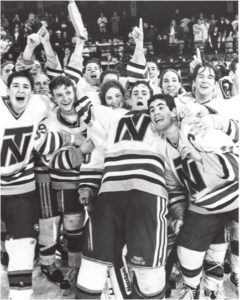
“I’m not.” But my team has extra spark, skating faster, hitting harder. I’m so focused and highly tuned, the puck seems to move in slow motion. Then the game is over. We won. I say nothing. Parents and coaches are outraged. The three Loyola boys in the stands get suspended for a week. I never know their names. I don’t care. We win the High School State Championship that year, in the new United Center. The front page of our home town paper shows me surrounded by my teammates, holding up our pointer fingers in a gesture of number one for the camera.
*
I am eighteen years old and playing women’s hockey for the first time for Dartmouth College. Women’s hockey is a huge adjustment, both on and off the ice, and I’m not adjusting well. I want to get better, I want to continue to improve, and I’m frustrated when I’m told my wants are selfish. I miss soccer, I miss running, but still, I plod along at the rink. Winning isn’t the problem, our team is good and we win the Ivy League Championship. But my love for the sport continues to fade.
A year later, we have made it to the final four of the ECAC tournament. We are playing odds on favorite University of New Hampshire. They are supposed to blow us out. The UNH coach is the current coach of the national team. Her name is Kathy Kline, she is a short round woman with tight curly hair shaped like a mullet. There is no love lost between us. The goalie at the opposite end of the ice is always invited to national camp. But I know I’m better, and throughout the game, I show it. By the end of the game, we are tied one to one though UNH has outshot us three to one. My body takes over and makes save after save. The crowd is cheering for us, we are the underdogs and we can beat them. I am having fun, this is fun,the game is a reminder of why I used to love the sport. Eight minutes into overtime, a pass from behind the net finds an open UNH player in front. She shoots and beats me glove side. It is a devastating loss. Kathy Kline gives our team no credit. When reporters ask about my play, she quips, “Half the time, I don’t think she even knew the puck hit her.” Right. And classy. A few days later, one of those same reporters writes, “The game revolved around the incredible goaltending of Sarah Tueting. Her play made that game a memorable event.” But it is clear, if Kathy is coaching the national team, I have no future in the sport.
It is a few months later and spring at Dartmouth College. I’ve found happiness running and training for a half marathon in the foothills of the White Mountains. A month earlier, I quit hockey. Despite the excitement of the ECAC game, going to the rink had simply ceased to be fun for me, and I wanted to experience my life without hockey. Running provided the calm, broad perspective and joy I needed to balance intensity run amuck. Freed from self-expectation, I had come alive again exploring the rich smorgasbord of experiences Dartmouth had to offer. I was done with hockey, we had broken-up. I didn’t love hockey and hockey didn’t seem to love me. It was time to move on.
Four months later, I am shocked to hear Ben Smith on the other end of a phone call to my parent’s house. Ben is the new national team coach. The US has never beaten Canada and USA Hockey finally fired Kathy Kline. Ben has called to invite me to the summer Olympic Development Camp. He said the previous coach didn’t think much of me, but when he asked around the league, more than a few coaches said he should give me a chance. He was willing to give me a chance.
I accept his invitation and a few weeks later, I put on my hockey equipment for the first time in months. Re-entry is horrible, I feel like a fat sloppy drunk slogging through mud. When did my equipment get so heavy? Why are my legs burning? Why can’t my eyes adjust to the speed of the puck? And all along, my love for the game remains uncertain.
A few weeks after my horrendous re-entry, I’m still struggling to regain my form when I step onto the 1980 rink in Lake Placid with new players, new coaches, hard shots, and fast, new and flowing game. I am tentative at first, wondering if anything remains of the love I once knew. But by the end of the week, all doubt is gone. I am once again, deeply in love with the game of hockey. I remember how much I love stepping out of the sunlight into the familiar smell of the rink, a strange combination of concrete floors, cinderblock walls, and rubber mats. I love the chiming of the buckles of my pads, and the feeling of cold air hitting my face after the laborious walk in goalie equipment disappears into effortless graceful fluid motion. I love the crisp pressure of the puck deflecting off my stick, and the gentle tug against my left wrist as I make a glove save. And of course, it shows in my play.
The first time I walked into a locker room and saw USA jerseys and socks hanging in the stalls is seared in my memory. I felt a sudden wave of overwhelming pride. I sat and looked around and some part of me couldn’t believe it wasn’t a dream. An hour later, I slipped into my red white and blue jersey and stood listening to the Star Spangled Banner with my teammates, with my name on the back of one of the jerseys. It was a small dose of heaven, and I wanted more. One week later, I declined to return to Dartmouth for my junior year. Instead, I decided to train full time in the hopes of playing in the 1998 Olympics, still two years away.
*
I am two weeks shy of my 21stbirthday at the World Championships in Kitchner, Ontario. For seven months, I have loved the simplicity of life: lift, skate, eat, rest, get stronger, get better, lift, skate, eat, rest. Everything else has fallen away. And I am getting better. I have played great games in China, Canada, and at home. Now we’re at the World Championships, the culmination of the season. I am ready and I want to play. But I don’t see the ice once, not a single start. I wipe madly at tears of frustration and shame while I plead my case to our sports psychologist.
“Ben won’t even give me a chance. Not even against Norway or Sweden? We beat them 10-0.” As if I couldn’t win that game. The shrink merely listens as my victim takes over. “I don’t understand, I’ve worked hard, I’ve done everything asked, I should be allowed to play.” A part of me mocks my whiny self, her self-pity would normally make my skin crawl. But that day, it was my victim’s show so she whined and moaned for a bit longer.
“Look, you’ve had a great year, but you’re still a rookie,” Peter finally interrupts. This is a huge sore point.
“Rookie doesn’t mean shit. I’m a goalie. I don’t believe in rookies. I don’t believe any team member needs to sit near the bathroom, or eat last, or have their heads shaved, or schlep bags more than any other member of the team. I carry my weight, rookie doesn’t mean shit.” I repeat. Peter looks at me. I look back. “What? So you’re saying because I’m a rookie, I should be happy just to be here? That’s crap, it’s not fair.” Eight months ago, I would have agreed with Peter. Eight months ago, I would have been thrilled just to be here. But now I want to play. I want to be in the game. Peter sits and stares at me for what seems like forever. My ragged breathing slows, the tears stop falling. “It’s not fair,” I repeat. He’s still silent. I sit, embarrassed and frustrated by the whine in my voice. Finally, he leans forward, and says,
“Ok Sarah.” Pause.
“It is not fair.” Really long pause. He’s agreed with me.
“So what?” He asks.
And just like that, the world shifted. Peter asked a simple question, but what I heard was, You’re right, it’s not fair. And there is nothing you can do. Nothing. Not one thing.
Now how are you going to react? You can cry. Or you can use the disappointment to drive you forward to be ready when the time comes. Grow up. Life isn’t fair.
I mature years in the course of five minutes. I sit in silence. Life isn’t fair. Fuck. It is true. Acceptance. My spine straightens and clingy wet emotions slide off me into a puddle on floor, along with my dramatic victim driven self. In their place, a fierce and tenacious calm rises from my low back and moves through the top of my head. It is not fair. Life is not fair. So be it, this is the hand I’ve been dealt, and I’ll play this hand too. I’m a fighter. I’m a survivor. Bring it.
*
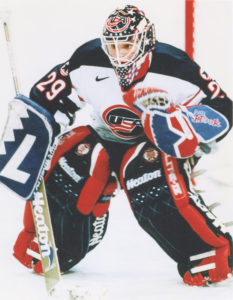
Ten months later, I’m in Nagano, Japan, playing in the gold medal game of the 1998 Olympics. I am in goal, and all I see is the puck. Chico long ago taught me to focus my mind, Shane taught me to channel my emotion, Wally and my grandmother taught me to believe in myself. I am a goalie. This is what I do. And I do it well.
Later, I will watch the tapes and see the painted faces with red white and blue. Later, I’ll notice the signs reading ‘Go USA’ and the one reading ‘Tueting’ with remarkably well drawn hockey pads and the words ‘USA gold’. Later I will hear music during the stoppages of play and fans chanting faceoff at each puck drop. Later, I will remember what it felt like to see the Olympic rings painted into the ice and my teammates wearing USA on the bench.
But during the game, all I see is the puck. Just pure puck. I will vaguely remember a big save with two minutes left, one that would have allowed Canada to tie the game at 2-2. But mostly, I don’t remember anything about the game until Whytie, my roommate, teammate and friend, scored an open net goal to make the score 3-1.
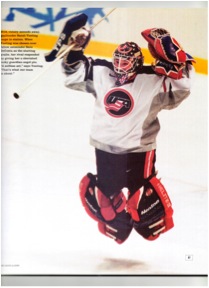 In that moment, the game ends. Joy possesses my body, I jump up and down, kicking my legs, arms flailing in relief, joy, disbelief, and pride. There are eight seconds left, we line up, the puck drops, and the buzzer sounds. I’m knocked down and piled on by my teammates. I can’t breathe. I’m literally being crushed. I’m so happy. We disentangle, hugging, throwing our hands up in joy, crying. I find my family in the stands and wave. Our team holds hands as we receive the first Women’s Olympic Hockey Gold Medals in history. My brother throws me a Styrofoam Uncle Sam hat. I call my Grandma from the locker room. I can picture her perfectly in her house robe (its early morning in Minnesota), smiling ear to ear. After much celebrating, I collapse in my stall and watch teammates open bottles of champagne, spraying each other, laughing, crying, hugging. I’m so full, I can’t take any more in. So for fifteen minutes, I just sit. Then I shower and change and go out to meet dozens of microphones. I can’t stop laughing. I don’t know what I’m saying as I answer their questions, but I can tell the reporters are having fun, sharing in the joy. We load the bus, all of us wearing our medals, to go celebrate with our families. As the bus pulls up to the hotel, I see my parents, walking on the sidewalk, laughing, hugging, and holding hands. I never see them hold hands. Suddenly, I see all the weekends and time and money they spent taking me to hockey. I see all the times they protected me and my love of the game from people who said girls shouldn’t play hockey. Later, I will send them a poem I find on the internet,
The Goalies Mom
I’m sure you’ve seen her at a hockey game
Although you may not know her name
She seldom sits with her friends or the crowd
Who get so excited and yell so loud
The rest of the teams they can give and take,
It’s the goalie who always make the mistake.
“Take him out” they holler “He’s a sieve!!”
“He doesn’t even deserve to live!!”
But when the contest is going the other way,
They have nothing but praise and good things to say.
“He’s stopping them all. Isn’t he great?”
“If he keeps this up, we’ll be going to the states”
When overtime comes, she can no longer stay
But goes to the lobby and starts to pray;
And cautiously listens to hear a loud roar
She then knows that one team have now made a score.
Her heart in her throat, she peeks at the fans
They are joyful, screaming and clapping their hands.
With a sigh of relief, she know her boy’s team has won,
So for now there won’t be any criticizing her son.
She says a quiet “Thank you God” as she starts to the door.
Today’s a happy ending, but she knows there’ll be more
Times when the goalie doesn’t come through.
There’ll be days when she’ll brush a tear from eye
And days when she’ll want to break down and cry,
For the player with the almost impossible task
Oh how she loves that child from behind the mask.
Yes, I’m sure you’ve seen this lady at one time or another
‘Cause she’s a special breed, she’s the goalie’s mother.
(I’d love to give credit to the author, but can’t find her name)
 I sit in pure joy, with a gold medal with a hockey player on it hanging around my neck. I love hockey. I love being a goalie. I love my teammates. I love all the lessons I’ve learned through hockey, and I love how hockey has shape who I’ve become.
*
The months following are a joyful ride of appearances, TV shows, autograph signings, and opportunities. I visit kids and schools and give speeches. I help Newt Gingrich, current Speaker Of The House launch an anti-drug campaign. I appear on Letterman and the Today Show and a half dozen local stations. I ride in a private plane. I play in celebrity charity games in Idaho and Wyoming and LA. I meet a hair stylist named Danilo at a Rolling Stone photo shoot who cuts my hair shoulder length. I have my picture taken by Annie Liebowitz for a magazine. I stay at the Plaza where a coke costs $8. I throw out opening day pitches at the Chicago Cubs and Chicago White Sox. My team throws out the pitch at a New York Yankees game. We are the most unexpected of heroes and the attention is dizzying.
And then I need a break. I rent a condo in Wyoming and for the month of May, I hike and write and hang out by myself, trying to regain my equilibrium. I have a bit of money, a bit of celebrity and I’ve achieved a dream. Now what?Because clearly what I’ve experienced is not the purpose of life. I don’t want to peak at twenty-one. So I hike and think and write and search for meaning.
Two months later, I’m giving a clinic at a local rink followed by an autograph signing session. The kids love to pose with the medal, and the joy in their eyes makes me laugh, each and every time. Suddenly a man approaches from the side.
“Sir, the line is back there,” the woman behind me says.
“Yeah yeah, he dismisses. I don’t want an autograph.” I look up. The man looks vaguely familiar and I feel a vague unpleasant association with his voice.
“Do you know who I am?”
I’ve learned to just say, “I’m sorry, I don’t.”
“I’m the one who cut you from the Pee Wee AAA team.” I stare at him and his big stupid pudgy grin. “My friends all made funny of me during the Olympics.” He says, slapping me on the shoulder. “Thanks a lot,” he jokes, as if we are chums, as if he didn’t steal some piece of my childhood notion of a fair world. Then he waits in expectation for me to respond. I won’t give him the satisfaction of a reaction.
“Excuse me please,” I say and turn back to the kids.
A few months later, I’m eating lunch at a local pizzeria with my first real boyfriend. Jack is cute and funny and works for the Blackhawks. We met while I was dropping the opening puck during a welcome home shindig at the United Center, the same rink where only four years prior, my high school team had won the State Championship. That day, Jack is wearing my high school hockey hat.
“Did you play hockey at New Trier?” The waiter asks Jack.
“I did,” he lies. It’s a somewhat pathetic inside joke, the chick girlfriend who plays hockey, the boyfriend who works for a hockey team. Jack was actually a Loy Boy, graduating four years before me.
“Did you know that girl in the Olympics? She went to New Trier, Sarah?” He asks.
“I knew who she was,” Jack says as I bury my head in my diet coke.
“My friend was her goalie partner in high school. But you know, her Dad paid the coach to play her over Sam, my friend, so she’d keep her scholarship to college.”
I look up. It’s bullshit, total bullshit. And immediately Sam and his parent’s images come to mind. I could see one of them saying that, I could. But I can’t let it go. “Really?” I say. “Because didn’t she go to Dartmouth? And I know Dartmouth doesn’t give athletic scholarships because I went there. So that seems sort of odd that her Dad would pay money, and incidentally that a coach would acceptmoney, to play her to maintain a scholarship that doesn’t exist.”
The waiter looks at Jack who is grinning ear to ear. Then the waiter looks at me. Ten minutes later, a different waiter brings us our lunch.
*
After the 1998 Olympics, I take a year off of hockey. I return to Dartmouth and finish my degree. I spend time in nature. I am twenty-three when the coach calls to see if I want to attend camp. I miss hockey. But what I really miss is the quiet mind, the meditative state of practice, when nothing else matters. I miss being in the zone. I miss the myopic focus. I miss the simplicity. I start skating and working out again. And my life takes on a familiar routine. Eat. Train. Sleep.
*
I am twenty-four years old, goalie for the US Women’s National Team, and tomorrow I’ll be starting against Canada in the gold medal game of the World Championships. But tonight, I am a mess. Actually, it’s morning, 1:30am. I should be sleeping with my roommates. Instead, I am crying, wandering the lonely stress of downtown Minneapolis, trying to figure out what I did wrong. Eight hours ago, my boyfriend of three years and former Loy Boy, Jack called to confess he ‘sort of’ cheated again with a girl named Mollie.
“I feel so guilty,” he said.
“I’m not good enough,” he said.
“All I do is hurt you,” he said.
“We should break up,” he said.
The call was part of a pattern I recognized way too late, a pattern of fighting and drama he creates around any big even of my athletic life, a pattern recently exacerbated by his new job as errand boy for the Blackhawks. But it has been a hard year, and I’m shaky and fragile. Eight hours ago, I actually offered to abandon my teammates, my goals – everything I’ve worked years for –to drive to him to work it out, a fact that continues to make me cringe decades alter. I don’t know that person now, I hate that she ever existed, but she did. I knew I wouldn’t actually abandon my teammates, I also knew it was what he needed to hear. What I didn’t understand then is words have energy, that shit travels further than we know.
And that night before the gold medal game, the dark Minneapolis night seeps into my soul. I am a shell. I feel weak and alone as a group stumbles out of a bar. There is only a tiny voice left to remind me of who I once was. The shakiness shows on the ice, in my friendships and with my teammates. I’m exhausted physically, mentally, emotionally, and spiritually when we hit the ice the next day. I have slept for three hours. We lose to Canada 3-2. A month later, Ben calls to tell me what I already know, the loss was my fault. I let my team down. I try hard to remember Wally’s words.
*
Eight months later, it is the 2002 Olympics, and my love of hockey is truly in jeopardy. I’m repeating my performance from the previous spring. I’m exhausted on every level. It’s been a long season of injuries, a slow-motion disintegration of my relationship with Jack, an unpredictable coach, feelings of depression, and intense clashing with a handful of teammates. I’m drained. I’m exhausted. I want to go home. And I’m competing in the Olympics. I’m supposed to be happy. I smile for cameras. I make appearances for Nike to show my helmets. The other goalie and I are part of their marketing campaign. On one of my helmets, an artist has painted a lighthouse and a lotus flower. My second helmet shows a painting of me eyes wide open and another with me, eyes closed in meditation. I am miserable as I explain the meaning and symbolism behind the project. It represents internal calm versus external focus. Hockey is meditation for me. I used to love this sport.
My family and friends do their best to support me while Jack causes fight after fight. I cry during Olympic Processing. My puffy eyes in my credential picture will forever remind me I let Jack take that experience too. I did that. He picks a fight during Opening Ceremonies, one before a game, one after a game, on rest days. The seat in the car is pushed back, he’s been driving girls around in the middle of the night. I don’t even know who I am in the midst of all the drama, in the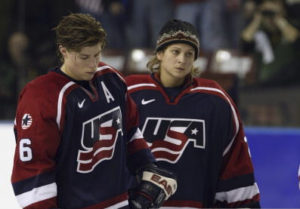 middle of the Olympics, the two weeks for which I’ve trained for three years. I’m sad and anxious and irritable most the time. And yet, when the gold medal game begins, everything goes quiet. From the bench, I send all my remaining strength to my goalie partner. She got the start. I’ve had great games against Canada, and I’ve been shaky against other teams, and Sara has had a great pre-olympic tour. She earned her start, I did not. I’m disappointed and frustrated, but I have enough of myself left to know it’s not about me. I cheer from the bench and encourage my teammates best I can, but the year has been hard on everyone and the bond, enigmatic flow of energy that is more than the sum of its parts is missing on our team. In a series of strange bounces and bizarre plays, we lose to Canada 3-2. It’s the last time I wear my goalie equipment.
*
I retire from hockey. Jack and I break up. I leave them both behind and try to remember who I am without them. It’s hard. Very hard at first. And then it gets easier. I find yoga. My world expands. I travel to India and Nepal. I attend Stanford Business School and travel to Morocco. I take a job in medical devices and move to Minneapolis. I travel to Switzerland, London, and Paris. I meet my future husband, Dan. We travel to Italy, Turks and Caicos, and Africa. I don’t watch hockey or read about or talk about hockey. I get married and Dan cries with pride when he sees a short clip of the ‘98 gold medal game in a video my parents make for our wedding day. Dan has never seen me play hockey, real time or even in a video. He is so proud. I run, I bike, I hike, I play tennis. I don’t think much about hockey. It’s a love gone wrong.
*
It is 2010, I am thirty-three, and for the first time in eight years, I am heading to the rink to play in a hockey game. I haven’t worn my goalie equipment since the gold medal game of the 2002 Olympics, and I don’t think I ever will again. I will never be ok with being scored on. I would hate being a mediocre goalie, it’s just not fun. Instead, I am playing defense for the Park City Predators. Two months ago, at the insistence of a new friend, I put on forward skates and stepped on the ice. I fell flat on my face. It had been eight years, plus, forward skates are more rockered than goalie skates. I stood up and fell again. Oops. I laughed out loud, and my new teammates laughed. Olympian, my ass.I was terrible, truly terrible. I got better. I came to love skating out, I love attempting to catch a pass on my backhand, I love feeling myself improve, I love being winded between shifts, I love feeling the acceleration in my legs as I fight for a loose puck, I love high fiving my teammates, I love making mistakes without the red light going on, and I love skating back to give the goalie an encouraging tap on her white and black pads.
It’s so strange for me, to feel this love again. But it is there. As powerful as ever, but equally fragile. So I watch myself carefully. Do I still love this? Do I still want to skate? The answer comes back yes. I love going to the rink, I love the effortless glide when I first step on the ice. I love being in the locker room before and after games. New loves have come into my life, skiing, snowshoeing, mountain biking, road biking, tennis, writing; the list is long. And they get most of my attention. But hockey was my first love, we’ve been through so much together. I wonder if it is a love story that has no ending.
I am thirty-give. For years, Dan and I have been struggling to have kids when some random woman at the rink asks me, “Do you think your infertility is because you played hockey?” I shake my head. It is such a strange, bizarre, and outdated question. I feel the need to defend hockey and to tell the woman to piss off. But then if I express anger, my uterus may fall out, right? Instead, I just walk away.
The local high school game is starting soon and the kids are probably dressed, waiting for the coaches to come into the locker room for a pre-game speech. I help with the goalies from time to time, careful not to over-tax my love for hockey. The team we are playing has a girl goalie. In the locker room, I’m standing to the side when I hear Deven who is all bones and bravado, say,
“They have a chick goalie. We are so going to light her up.” I stare at this kid. How can he not know? I mean, of course he knows.
“Really Deven, because she’s a girl?” I ask.
“We’re going to light, her, up.”
It’s not my job to injure budding male egos, so I roll my eyes. We lose 4-1. The next day at practice, I skate up behind Deven where he is waiting in line.
“Hey, Deven, how many goals did you score in the game yesterday?”
“None,” he looks confused.
“Did you get an assist?”
“No,” he says.
“You mean, you and your line, you couldn’t even score once on the chick goalie?” I smile and pat him affectionately on the head.
“No m’am,” he smiles back.
“Right.”
*
My beautiful beautiful babies,
I hope you fall in love with as many things as possible. Find a sport, a musical instrument, painting, photography, finance, cooking, anything that ignites passion. And then hang on tight, and let it teach you about life and about yourself. Do you like to win or hate to lose? Does anger motivate you or distract you? When things are hard, do you fold into victimhood or can you experience disappointment with strength and grace? Do you like hard work or do you look for shortcuts? Do you let doubt paralyze you, or can you use it to drive yourself forward? Engage, love, learn, and listen for the lessons. And know as you go, that you may fall into and out of love, multiple times, and that’s ok. You aren’t always going to be madly and passionately in love with anything. The trick is can you fall in love with the same thing, the same person, the same passion again and again.
Also know that you don’t have to win championships or Olympic medals to have a passion be worth your time and 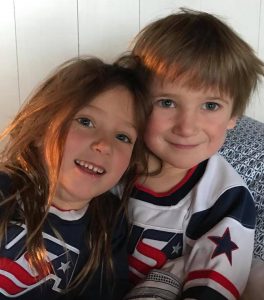 energy. That was a happy accident as women’s hockey didn’t even exist when I fell in love with hockey. Just fall in love, as often and with as many things as you can. Because there is so much to love about life. Try to remember that the importance of love stories is who you become in the process of loving. No love story is without bumps, that’s ok. Embrace them, embrace even the hard times, and let your passions teach you about yourself. I love you both, so much. I can’t wait to meet you. I can’t wait to witness your love stories. Love, Your Momma