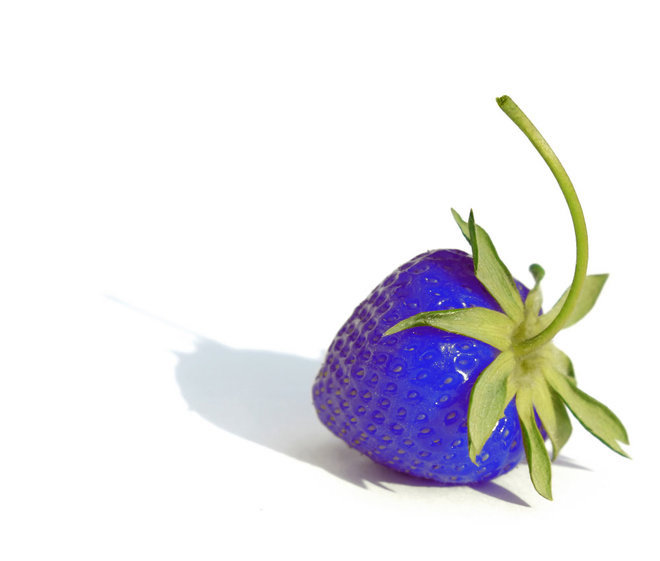
Here is a trippy bit of information: what you see as red I may see as blue, but name it “red.” Your color wheel may be rotated with to respect mine. This is definitely true of those with different types of color blindness who nevertheless name colors. But when it comes to perception and color, there may be no universal color wheel. The Neuroscientist in me gets all giddy thinking about stuff like this. And the yogi blisses out.
I can’t remember when I learned nothing in the world actually possesses color. What we perceive as color is wavelengths of light reflected off objects and picked up by cells in the retina called cones. These cells then propagate a signal in the optic nerve via a wave of traveling depolarizations across the cell membrane called an action potential. It is the occipital lobe of the brain that interprets the action potentials as color. The human eye responds to an extremely small percentage, only .0035%, of the electromagnetic spectrum. We only see wavelengths between 380 (violet) and 700 (red) nanometers. BUT, there are no predetermined perceptions ascribed to each of those wavelengths. Color is differentiated and named by our brain and how is has been influenced and shaped by the outside world. Not by the wavelengths themselves.
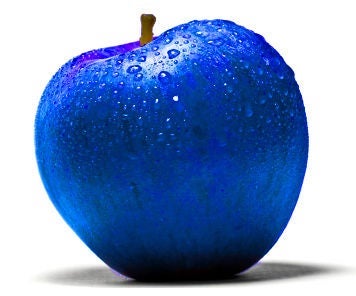
To add further dimensions to this insane concept that your “red” may actually be my “blue,” the distribution and density of different types of cones in the retina vary across people causing different action potentials to be propagated to the brain when exposed to the same wavelengths of reflected light. And even further downstream in the visual system, other factors such as mood, emotions and memories have been shown to affect our perception. It is possible two people can look at the same object, have the same wavelengths hit their eyes, and perceive something different.
So mind-trippingly cool, right? It’s quite obvious why the Neuroscientist in me is stupidly giddy. Why the yogi? Because the world is the same way. Life is a variety of vibrations. The world consists of elements of the periodic table put together in different configurations vibrating at different rates. It is the human that interprets these vibrations as good or bad, right or wrong, happy or sad. The purple blanket that makes me happy may make you sad. Skiing a steep mountain with deep snow may make you feel agitated, but may feel ecstatic to me. You may love the guitar because it allows you to express love. I may hate the guitar because someone wacked me in the head with one. You may love afternoon barbeques and late-night parties because they make you feel alive. I may avoid them because they make me feel sad and alone. Some people like to be dominated, some like to feel pain, some love loud music, some love beautiful sunsets, poetry and silence. I’m not sure any vibrations are universally perceived. A butterfly gently landing on one’s hand has a different vibration than a snake hissing, for sure, except if the person is pathologically afraid of butterflies and loves snakes as a divine calling. The relationship between the vibration received and perceived is not predetermined. Survival instinct and self preservation are the greatest human motivators, except in those who commit suicide. The love of a mother for her child is so great as to be beyond evolutionary necessity, except for the pregnant mother in Sri Lanka who blows up herself and her young kids. Even at the extremes, I cannot be certain a universal translator exists.
What I am certain of is this: people, places, things are chemical arrangements of protons, neutrons and electron orbitals we experience through our sensory system. As cold as that might sound to some, I find it stunningly beautiful because it distinguishes the soul as the experiencer, the end user of all of these sensory vibrations. Including the subtler vibrations of our thoughts and emotions. The soul is here to evolve through experience. It is the human that interprets, labels and demarcates the world as it comes in as right or wrong, good or bad, cling or resist, your blue or my red. Our hearts follow our minds, our minds justify our hearts. We muddy the waters with our human. We accumulate experiences and create layers that change and distort our perception of reality. No wonder we don’t feel satisfied. We store the stuff we really liked or really disliked, and those impressions become an interpreting machine that distorts vibrations before they make it to the soul. No wonder we don’t all get along. Everyone’s distortion filters are different based on their own unique experiences. We are literally perceiving different realities instead of the vibrations of the universe, as is.
What if we just experienced what is? Sigh. Do you feel the freedom in that? The peace. He who has ears, let him hear.She who has eyes, let her see. What if we lived such that the vibrations make it in cleanly to the soul? What if we could lose the filters? What if we could all just see? What if we could perceive reality without the distortion? Or perhaps to the same effect, be entirely conscious of our own distortions? If we could just see, we’d all see the same wavelength of light. If we could just see, we’d all see each other instead of trying to connect through a mess of distortions. If we could just see, we’d see oneness. We’d hear oneness. We’d be oneness.
That’s what makes the yogi giddy. Silly stupidly giddy.
~
Totally fascinating (to me anyway) tidbit of Neuroscience postscript

Though we may perceive color differently, we seem to have universal emotional responses to color. Shorter wavelengths that we perceive as blue tend to make us calm, while longer wavelengths like red, yellow and orange tend to make us more alert. Melanopsin is a photopigment found in photosensitive retinal ganglion cells, that is innately sensitive to short wavelength light. It measures the amount of blue or yellow in a scene as opposed to a playing an image forming role like rods or cones.* For instance, mice with no rods or cones still adhered to a circadian cycle based on light. In humans, the melanopsin-containing retinal ganglion cells communicate information to areas of the brain involved in circadian rhythm as opposed to perception. And the circadian system is a vital regulator of mood and emotional systems. That is, we feel happy or sad based on a totally different system than how we actually perceive color. Even if my “blue sky” is your “red” sky, the sky on a clear day still makes you feel calm because it is the shorter wavelength light (that is scattered more as light moves through the earth’s atmosphere) that impacts mood via melanopsin and the circadian system, not what name we attribute to the wavelength.
* Melanopsin is expressed in <.5% of cones, and only in the peripheral regions of the retina.
Leave a Reply